

Without category
Greece’s Island Property Boom Collides With a Hard Constraint: Infrastructure

Greece’s Island Property Boom Collides With a Hard Constraint: Infrastructure
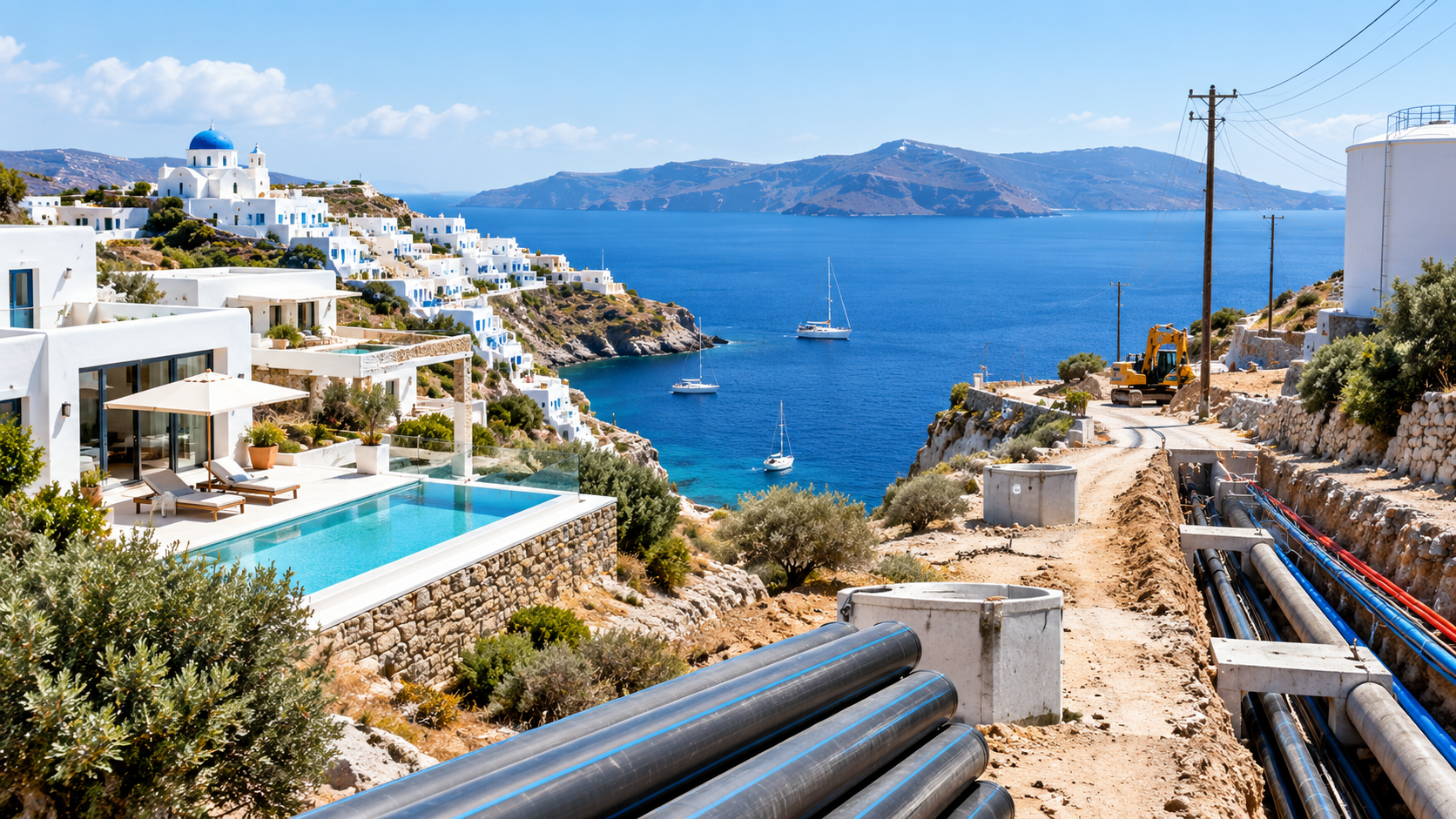
Greece’s island real estate market has spent the better part of five years as one of Europe’s standout growth stories, powered by record tourism, foreign capital inflows and a Golden Visa program that has funneled international buyers toward the country’s most desirable coastlines. But a September analysis has surfaced the constraint that increasingly threatens to cap that growth trajectory: infrastructure. Water supply, electricity capacity, wastewater treatment, road networks, airport capacity, port capacity and worker housing are all becoming binding limits on how much further island development can realistically expand — regardless of how much capital or buyer demand remains available.
The scale of the underlying tourism boom explains why the strain has become acute. Greece welcomed nearly 38 million visitors in 2025, a 5.6 percent increase over the prior year, generating roughly €23.6 billion in travel revenue, up 9.4 percent year-over-year. Building permits in Santorini and Mykonos have surged, and construction activity has nearly doubled year-over-year in secondary islands including Tinos, with similar booms recorded in Paros, Naxos, Milos and Antiparos. That is precisely the kind of demand curve that, in a market with unconstrained physical resources, would simply be met with more supply. Greek islands, however, are geographically finite in a way few mainland tourism markets are — water has to be shipped in or desalinated, power grids were built for a fraction of current peak demand, and there is no capacity to simply extend a highway or add another runway when a single island runs out of room.
The Greek government’s response has been to restrict supply directly rather than let market forces resolve the tension. Under the Special Spatial Framework for Tourism introduced in May 2026, Mykonos, Santorini, Skiathos and parts of Rhodes, Zakynthos and Crete have been placed under Category A “saturated” status, capping new tourist accommodation at 100 beds, mandating minimum hotel plot sizes of 1.6 hectares, and requiring carrying-capacity assessments before any new development proceeds. Santorini’s Caldera zone faces the most severe restrictions in the country: no new construction, no additions, no swimming pools, and critically, no new water infrastructure — a prohibition that functions as a de facto development freeze given that any meaningful project requires secure water access. Analysts estimate only a handful of individual plots remain immediately developable under the new framework, with most other parcels requiring complex property-pooling arrangements simply to meet the new minimum size thresholds.
The investment implication cuts in two directions simultaneously. On one hand, the supply freeze is a structural tailwind for existing, already-permitted inventory: Mykonos property prices reached roughly €7,622 per square meter in April 2026, and with virtually no new competing supply able to enter the saturated islands, owners of existing developable land or completed properties in Category A zones are sitting on an increasingly scarce asset. On the other hand, the freeze effectively closes off an entire category of opportunity for new capital — developers and investors who have not already secured land and permits in the saturated islands are, in practical terms, locked out of the market’s most prestigious addresses for the foreseeable future, forcing a redirection of capital toward secondary islands like Crete, Rhodes and Corfu, where infrastructure has more room to absorb growth and where port modernizations, airport upgrades across Fraport’s 14-airport Greek network, and expanding fast-ferry connections are actively being built out.
There is also a financing story unfolding beneath the real estate headlines that is worth watching closely. Investor capital is now flowing directly into the infrastructure bottleneck itself: the combined market capitalization of Greece’s two largest water utilities, EYDAP and EYATH, surged from roughly €750 million at the end of 2024 to approximately €1.25 billion by May 2026, while ADMIE, the operator of Greece’s power transmission grid, has seen its regulated asset base set to nearly double from €3.4 billion in 2025 to €6.9 billion by 2029. For sophisticated investors, that reframes the opportunity: rather than competing for an ever-shrinking pool of developable island land, the more structurally sound long-term play may be the utilities and infrastructure operators whose expansion will ultimately determine how much additional real estate value the Greek islands can support at all.


The global real estate market continues to be viewed as a safe and profitable investment, particularly in regions with high tourism demand or economic stability, such as the United States, Mexico, and Spain. Despite global economic fluctuations, properties in these areas remain attractive due to factors like population growth, sustained tourism, and ongoing urbanization. This article explores the reasons behind the resilience of this market and the innovative strategies enabling investors of all levels to participate.
Why Does the Real Estate Market Remain Attractive?
The real estate sector offers a unique combination of stability and growth potential. In the United States, cities like Miami, Austin, and New York draw investors due to their economic dynamism and high housing demand. In Mexico, tourist destinations such as Cancún, Puerto Vallarta, and Los Cabos attract both domestic and international buyers, driven by tourism and the interest of foreign retirees. Spain, meanwhile, combines a stable economy with vibrant real estate markets in cities like Madrid, Barcelona, and the Costa del Sol, where demand for vacation properties continues to grow.
These markets not only provide attractive returns through property value appreciation but also generate passive income through short- or long-term rentals. Additionally, the perception of real estate as a tangible asset strengthens its appeal during times of economic uncertainty, as investors see it as a way to protect their capital against inflation.
New Doors for Investors: Crowdfunding and REITs
Historically, the real estate market has been dominated by large investors and funds with access to millions of dollars. However, the rise of real estate crowdfunding platforms and REITs (Real Estate Investment Trusts) has democratized access to this sector, allowing individuals with smaller budgets to participate in large-scale projects.
Real Estate Crowdfunding
Real estate crowdfunding, powered by platforms like Briq.mx in Mexico or Simplestate in other markets, enables investors to collectively fund real estate projects, from residential developments to hotels and shopping centers. These platforms act as intermediaries, connecting developers with investors who can participate with amounts as low as a few thousand pesos or dollars. In return, investors receive returns based on the project’s profits, either from rentals or property sales.
This model not only lowers entry barriers but also offers transparency and diversification. For instance, an investor can spread their capital across multiple projects in different regions, minimizing risks. Furthermore, the digitization of these platforms allows for quick and easy access, with detailed information about each project, from financial projections to the developer’s track record.
REITs: Real Estate Investment in the Stock Market
REITs are another attractive avenue for those seeking exposure to the real estate market without directly purchasing properties. These publicly traded funds invest in a diversified portfolio of real estate assets, such as offices, shopping centers, or housing, and distribute most of their profits as dividends to shareholders. In markets like the United States and Spain, REITs are particularly popular due to their liquidity and tax benefits.
Investing in REITs is ideal for those who prefer to avoid the responsibilities of managing properties, such as maintenance or dealing with tenants. Additionally, as tradable instruments on the stock market, they offer flexibility to enter and exit the market more easily than traditional real estate investments.
Challenges and Considerations
Despite its advantages, the real estate market is not without challenges. Fluctuations in interest rates, changes in tax policies, and risks associated with natural disasters or economic crises can impact profitability. In the case of crowdfunding, it is crucial to research the reputation of platforms and the feasibility of projects, as not all offer the same guarantees. Meanwhile, REITs, though liquid, are subject to stock market volatility, which can create short-term uncertainty.
Conclusion
The global real estate market remains a cornerstone for investors seeking safety, profitability, and diversification. Regions like the United States, Mexico, and Spain stand out for their potential, driven by tourism demand and economic stability. Thanks to innovations like real estate crowdfunding and REITs, access to this market has been democratized, allowing more people to participate in multimillion-dollar projects with modest investments. However, as with any investment, thorough analysis and diversification are essential to maximize benefits and minimize risks.
If you’re considering entering the real estate market, whether as a novice or experienced investor, now is the time to explore these opportunities. Platforms like Briq.mx or Simplestate, along with REITs, are opening a world of possibilities for everyone to benefit from the global real estate boom.


The Super Mansion Market in 2026

The Best Real Estate Business Models for the Elite in 2026

Investing in the World’s Tallest Buildings

Maldives: Eagle Hills Advances a $12 Billion Waterfront and Marina Vision

Dubai: Emaar’s $55 Billion Urban Bet
