
Today
Why the Top 10 REITs of April 2025 Are Considered Real Estate


Introduction to REITs
Real Estate Investment Trusts (REITs) are companies that own, operate, or finance income-generating real estate assets, such as buildings, land, or infrastructure. They provide an accessible way for investors to gain exposure to real estate without directly purchasing or managing properties. REITs trade on stock exchanges, offering liquidity, and are required to distribute at least 90% of their taxable income as dividends, making them attractive for income-focused investors. To qualify as a REIT, at least 75% of their assets and income must derive from real estate activities, such as rents or mortgage interest. REITs span diverse sectors, from logistics to telecommunications, but all center on physical properties, cementing their place in the real estate sector.
This article examines the top 10 REITs by market capitalization for April 2025, detailing their business models, why they are classified as real estate, and their relevance in today’s market. The list has been refined based on recent data and trends, ensuring accuracy for 2025.
Why Are They Real Estate?
Real estate encompasses land and physical structures (buildings, towers, or improvements) that generate income, primarily through leases. REITs fit this definition because they:
-
Own physical properties: Buildings (warehouses, data centers), towers, or land.
-
Generate rental income: Lease space to tenants, from tech firms to casino operators.
-
Depend on location: Property value hinges on geographic factors (e.g., proximity to ports or internet hubs).
-
Adhere to REIT regulations: At least 75% of assets and income come from real estate, with 90% of taxable income distributed as dividends.
The Top 10 REITs for April 2025: Business and Real Estate Classification
-
Prologis (PLD)
-
Sector: Logistics and Industrial.
-
Business: The world’s largest REIT, Prologis specializes in warehouses and distribution centers for e-commerce and logistics. It acquires or develops warehouses in strategic locations (near ports, highways) and leases them to companies like Amazon or FedEx. It manages ~1.2 billion square feet across 19 countries.
-
Why it’s real estate: Owns physical buildings leased long-term (5-15 years). Property value depends on proximity to supply chain hubs, a core real estate principle.
-
Revenue: Lease rentals and property management services.
-
Sustainability: Invests in solar roofs, BREEAM certifications, and recycled materials.
-
Example: A warehouse in Shanghai leased to Alibaba, located near a major port.
-
-
American Tower (AMT)
-
Sector: Telecommunications.
-
Business: Operates the largest independent portfolio of wireless and broadcast communication towers globally. It leases tower space to mobile operators (e.g., AT&T, Vodafone) for 5G antennas.
-
Why it’s real estate: Towers are physical structures on owned or leased land, generating rent based on strategic coverage locations.
-
Revenue: Long-term lease agreements.
-
Sustainability: Uses renewable energy (solar/wind) for towers.
-
Example: A tower in rural Texas leased to Verizon for 5G, on a strategically located plot.
-
-
Equinix (EQIX)
-
Sector: Data Centers.
-
Business: Manages global data centers for cloud computing, AI, and streaming. It leases rack space, power, and network connections to firms like AWS or Netflix, operating ~260 centers in 33 countries.
-
Why it’s real estate: Data centers are physical buildings leased to tenants, with value tied to proximity to internet hubs.
-
Revenue: Rentals for space and interconnection services.
-
Sustainability: Targets 100% renewable energy by 2030, with LEED certifications.
-
Example: A data center in Tokyo leased to Google Cloud, near a network hub.
-
-
Welltower (WELL)
-
Sector: Healthcare Infrastructure.
-
Business: Invests in senior housing, medical facilities, and healthcare properties across the U.S., Canada, and the UK. It leases to healthcare operators or manages properties directly.
-
Why it’s real estate: Owns physical buildings leased to tenants, with value driven by locations near aging populations.
-
Revenue: Lease rentals and property management income.
-
Sustainability: Pursues WELL certifications and energy efficiency.
-
Example: A senior living facility in London leased to an operator, in a retiree-heavy area.
-
-
Public Storage (PSA)
-
Sector: Self-Storage.
-
Business: Operates self-storage facilities in the U.S. and Europe, leasing units to individuals and businesses for storing goods. It manages ~3,000 properties.
-
Why it’s real estate: Owns physical buildings leased for storage, with value in urban or suburban locations.
-
Revenue: Rentals from storage units.
-
Sustainability: Solar panels and energy-efficient systems.
-
Example: A storage facility in Miami leased to small businesses, near a commercial district.
-
-
Realty Income (O)
-
Sector: Retail.
-
Business: The largest triple-net lease REIT, owning retail stores, pharmacies, and supermarkets leased to defensive tenants (e.g., Walgreens). Tenants cover taxes, maintenance, and insurance.
-
Why it’s real estate: Owns commercial buildings leased long-term, with value in high-traffic areas.
-
Revenue: Stable lease rentals.
-
Sustainability: Energy-efficient systems, ENERGY STAR certifications.
-
Example: A Walmart store in Georgia leased under triple-net terms, in a busy retail zone.
-
-
Digital Realty Trust (DLR)
-
Sector: Data Centers.
-
Business: Operates data centers for cloud computing and connectivity, leasing space and services to tech firms (e.g., Google, IBM). It manages ~300 centers globally.
-
Why it’s real estate: Data centers are physical buildings leased, with value in network hub proximity.
-
Revenue: Rentals for space and connectivity services.
-
Sustainability: Renewable energy, LEED certifications.
-
Example: A data center in Sydney leased to Salesforce, near an internet exchange.
-
-
Crown Castle (CCI)
-
Sector: Telecommunications.
-
Business: Owns communication towers in the U.S., leasing them to mobile operators for 5G equipment.
-
Why it’s real estate: Towers are physical structures on land, leased based on location.
-
Revenue: Lease rentals.
-
Sustainability: Renewable energy and efficiency monitoring.
-
Example: A tower in Seattle leased to T-Mobile, on urban land.
-
-
Iron Mountain (IRM)
-
Sector: Data Storage.
-
Business: Operates physical storage facilities (documents, tapes) and data centers for information management, leasing space to businesses.
-
Why it’s real estate: Owns physical buildings leased, with value in proximity to business hubs.
-
Revenue: Rentals and data management services.
-
Sustainability: Renewable energy, LEED certifications.
-
Example: A storage facility in Boston leased to a law firm, near downtown.
-
-
VICI Properties (VICI)
-
Sector: Entertainment and Casinos.
-
Business: Owns casinos, hotels, and entertainment properties (e.g., Caesars Palace), leased to operators under triple-net agreements.
-
Why it’s real estate: Casinos are physical buildings leased, with value in tourist destinations.
-
Revenue: Stable lease rentals.
-
Sustainability: Water efficiency, solar panels.
-
Example: The Venetian in Las Vegas leased to a casino operator, on prime land.
-
Comparative Table: Top 10 REITs for April 2025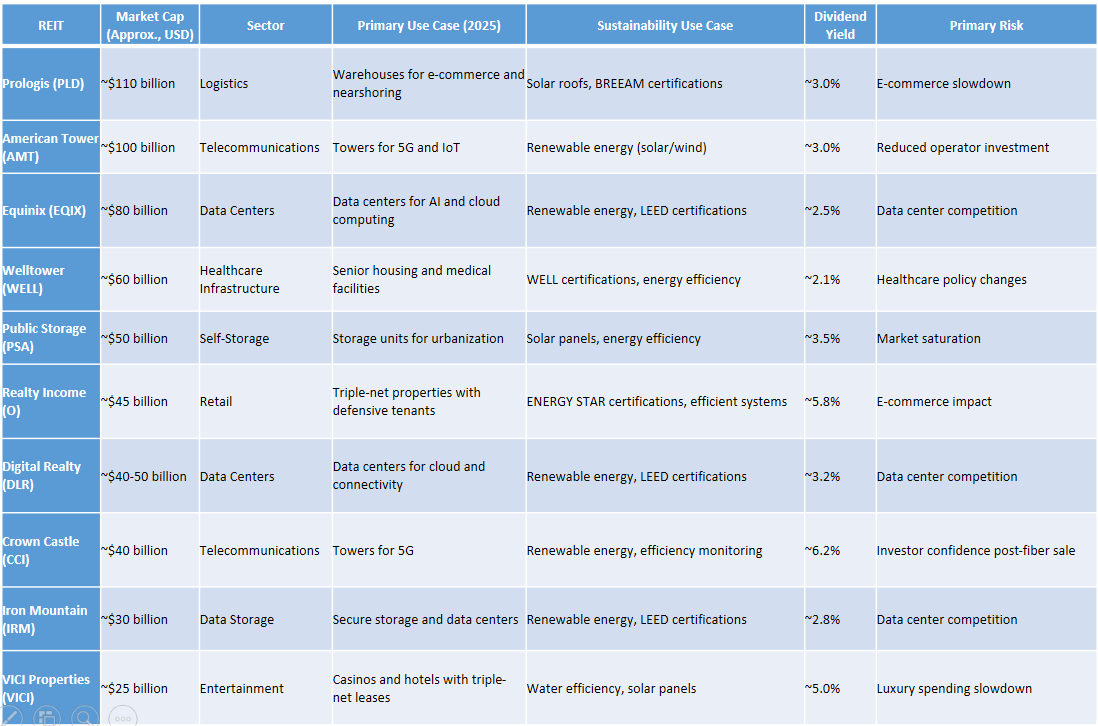
Table Notes:
-
Market Capitalization: Estimates based on April 2024 data (Statista, Morningstar) and 2025 projections, adjusted for sector trends.
-
Dividend Yield: Approximations from Morningstar, U.S. News, and other sources, where available.
-
Order: Sorted by approximate market capitalization, with Prologis as the global leader.
The top 10 REITs for April 2025 are firmly rooted in real estate, owning and leasing physical properties—from warehouses to data centers—that generate rental income. Their business models hinge on tangible assets, strategic locations, and long-term leases, aligning with core real estate principles. This updated list, incorporating Public Storage and Digital Realty Trust, reflects 2025 trends like AI, e-commerce, 5G, and sustainability, ensuring accuracy over the original inclusion of smaller or less relevant REITs. All REITs are adopting ESG practices (renewable energy, certifications), enhancing their appeal. Market cap values may fluctuate, but these REITs are poised to lead. Conduct your own due diligence and consult a financial advisor before investing.



-
hese 10 countries stand out in 2026 for their combination of ROI, stability, lifestyle, and legal frameworks favorable to foreign investors. Here’s an in-depth look at each:
1. Mexico 🇲🇽 – Estimated ROI: 8%–13%
Recommended Areas: Tulum, Playa del Carmen, CancúnMexico stands out for its blend of natural beauty, low cost of living, and high profitability. Tulum and Playa del Carmen are world-class destinations with white sand beaches, cenotes, and Mayan ruins, attracting thousands of tourists and digital nomads monthly. Cancún, with its international airport and luxury resorts, draws global tourism. The Riviera Maya offers a balance of pristine nature and modern amenities. Continuous infrastructure improvements like the Tren Maya boost its appeal further. Properties appreciate quickly, and Airbnb yields high annual occupancy. Legal trusts (fideicomisos) ensure safe purchases by foreigners. In many tourist areas, ROI exceeds 10%, making Mexico a gem both for living and generating income.
2. Portugal 🇵🇹 – Estimated ROI: 7%–10%
Recommended Areas: Algarve, Setúbal, PortoPortugal has moved up the ranking as one of the fastest-growing property markets in the world: home prices have climbed roughly 48% over the past five years, and the momentum has held into 2026. The Algarve features stunning beaches, top-tier golf courses, and charming fishing villages perfect for vacation rentals. Setúbal continues growing as a luxury second-home area, while Porto stays trendy thanks to its culture and wine scene. High safety, a moderate cost of living, and steadily rising property values make Portugal a standout for both lifestyle and income — particularly for investors from Northern Europe and North America.
3. Costa Rica 🇨🇷 – Estimated ROI: 8%–12%
Recommended Areas: Tamarindo, Nosara, GuanacasteCosta Rica is known for its political peace, economic stability, and environmental consciousness. Pacific beaches like Tamarindo and Nosara offer lush landscapes, world-class surfing, and a laid-back lifestyle. The eco-friendly approach attracts conscious investors and tourists looking for authentic experiences. No capital gains tax on real estate is a major advantage. Guanacaste combines natural beauty with high tourism demand and a growing expat and retiree community. Remote work is encouraged, and high-speed internet is available even in coastal zones. Buying is easy for foreigners, and the vacation rental market remains strong.
4. Dubai 🇦🇪 – Estimated ROI: 5%–8%
Recommended Areas: Downtown, Marina, JVC, Business BayDubai still blends luxury, safety, world-class infrastructure, and unique tax advantages — no income or real estate capital gains tax. It remains a global hub for business, tourism, and tech, attracting international talent and capital. Downtown and Marina areas feature futuristic architecture in high demand from tourists and executives alike, while JVC caters to a growing middle class seeking modern apartments. Yield expectations have moderated somewhat compared with the peak years: modern flats in districts like Business Bay and Jumeirah Village Circle now average 5%–7% rental returns, still supported by high occupancy and strong long-term rental demand.
5. Colombia 🇨🇴 – Estimated ROI: 8%–10%
Recommended Areas: Medellín, CartagenaColombia remains a top destination for high returns and low entry costs. Medellín has transformed into a modern, innovative city with eternal spring weather, great cuisine, and efficient transport. El Poblado is a favorite among digital nomads with coworking spaces, cafés, and nightlife. Cartagena offers Caribbean beaches and colonial history with strong international tourism. Foreign investment in property continues rising, and Airbnb activity is booming. Real estate is still very affordable, and urban renewal projects keep boosting downtown values.
6. Greece 🇬🇷 – Estimated ROI: 7%–10%
Recommended Areas: Athens, Crete, SantoriniGreece offers history, Mediterranean beauty, and Schengen zone access. Athens combines ancient charm with modern living, making it ideal for long-term and urban rentals. Islands like Crete and Santorini boast turquoise waters and whitewashed architecture, ranking among the most sought-after tourist spots in Europe. Seasonal rental demand is very high, and although property prices keep rising, they remain competitive. The Golden Visa program has attracted foreign investors since 2013, and Greece has stabilized its economy and upgraded tourism infrastructure.
7. Spain 🇪🇸 – Estimated ROI: 6%–9%
Recommended Areas: Málaga, Alicante, Costa del SolSpain offers a perfect climate, globally recognized beaches, and a top-tier transport network. Costa del Sol boasts over 300 days of sunshine per year, attracting European tourists and investors. Málaga is booming with new cultural, tech, and urban projects. Alicante blends traditional architecture, sea life, and affordability. Spain has clear property laws, and short-term rental demand keeps rising. Investor visas are available for non-EU citizens, and coastal areas retain value over time thanks to high tourist turnover.
8. United States 🇺🇸 – Estimated ROI: 7%–10%
Recommended Areas: Miami, Tampa, Austin, PhoenixThe U.S. remains one of the world’s most transparent and stable markets. Miami offers glamour, sun, and top Airbnb demand. Tampa and Phoenix are booming with population growth and affordability. Austin mixes tech, youth, and strong rental demand. Property laws favor landlords, and investors can use LLCs or trusts to purchase from abroad, with flexibility for long-term rentals, vacation rentals, or flipping.
9. Türkiye 🇹🇷 – Estimated ROI: 5%–7% (new entry)
Recommended Areas: Antalya, IstanbulTürkiye has climbed into the top tier of yield-driven markets through 2026. Seafront apartments in Antalya and Istanbul typically deliver around 6% yields, supported by growing domestic and foreign buyer interest. Relatively low entry prices compared to Western Europe, combined with strong tourism-driven short-term rental demand, make it an increasingly attractive pick for investors chasing cash flow rather than pure appreciation.
10. Georgia 🇬🇪 – Estimated ROI: 6%–7% (new entry)
Recommended Areas: TbilisiGeorgia has emerged as one of the standout rental-yield markets in the region. In Tbilisi, short-term rentals can generate up to 7% annually, driven by strong demand from tourists and remote workers. Low property costs, straightforward foreign-ownership rules, and a growing digital-nomad scene support the case for Tbilisi as an accessible, high-yield entry point.
Summary Table
Rank Country Recommended Areas Estimated ROI Key Benefits 1 Mexico 🇲🇽 Tulum, Playa del Carmen, Cancún 8%–13% Rapid appreciation, tourist demand, Airbnb-friendly, strong legal framework 2 Portugal 🇵🇹 Algarve, Setúbal, Porto 7%–10% Strong five-year price growth, tax-friendly, growing expat interest 3 Costa Rica 🇨🇷 Tamarindo, Nosara, Guanacaste 8%–12% Eco-lifestyle, tax advantages, growing digital nomad presence 4 Dubai 🇦🇪 Downtown, Marina, JVC, Business Bay 5%–8% No taxes, futuristic city, strong occupancy 5 Colombia 🇨🇴 Medellín, Cartagena 8%–10% Affordable, high demand, rising international profile 6 Greece 🇬🇷 Athens, Crete, Santorini 7%–10% Golden Visa, strong seasonal rental market 7 Spain 🇪🇸 Málaga, Alicante, Costa del Sol 6%–9% Sunshine, legal clarity, rising tourism 8 USA 🇺🇸 Miami, Tampa, Austin, Phoenix 7%–10% Transparent markets, legal security, flexible strategies 9 Türkiye 🇹🇷 Antalya, Istanbul 5%–7% Low entry cost, strong coastal rental yields 10 Georgia 🇬🇪 Tbilisi 6%–7% High short-term rental yields, easy foreign ownership Sources:
Immigrant Invest
Benoit Properties
Mirabello Consultancy
Estate Agent Power
Elite Luxury Real Estate

Sustainable Real Estate in 2026: A Ranking Reshuffle and What It Means for ESG-Focused Capital
Real estate’s sustainability leaderboard looks meaningfully different heading into the back half of 2026 than it did even twelve months ago — not because the sector’s underlying ESG commitments have weakened, but because the industry’s most-watched scorecard, the Corporate Knights Global 100 Most Sustainable Corporations ranking, overhauled its methodology this year in a way that has reshuffled the entire list, real estate included.
Why the Ranking Changed
The 2026 edition of the Global 100 introduced a new core metric called sustainable revenue momentum — how fast a company is growing the share of its revenue tied to sustainable activities — which now accounts for a full third of every company’s score, alongside overall sustainable revenues and sustainable investments. The effect was immediate and dramatic: Italian renewable energy producer ERG SpA, ranked just 18th a year earlier, jumped to first place in 2026, while Schneider Electric, last year’s top performer, fell all the way to 40th. Thirty-seven companies entered the ranking for the first time this year and 33 dropped off entirely — a level of turnover that Corporate Knights’ director of rankings, Michael Yow, has explicitly framed as a deliberate signal that speed of transition now matters as much as absolute sustainability performance. For real estate specifically, that shift rewards companies actively growing green-certified, energy-efficient and renewable-powered portfolios faster than peers, rather than simply companies that reached a high sustainability baseline years ago and have since plateaued.
City Developments Limited Remains the Sector’s Clearest Global 100 Representative
Amid that turnover, City Developments Limited (CDL) has held its position as Singapore’s — and one of the world’s — most consistently ranked sustainable real estate companies, landing at 69th place in the 2026 Global 100 and retaining its billing as Singapore’s top-ranked real estate and leasing company on the index. That continuity matters more this year than in past editions precisely because so many companies fell off the list entirely under the new momentum-weighted methodology; CDL’s survival reflects sustained, measurable progress rather than a one-time ESG initiative. The company’s net-zero-by-2030 operational target remains in place, built around continued emissions reductions since its 2017 baseline, an expanding solar footprint across its portfolio, and integration of low-carbon materials into new developments — with the added dimension in 2026 of leaning more heavily into smart-building and circular-economy design principles as differentiators in an increasingly crowded field of ESG-branded developers across Asia.
Prologis: Still a Sustainability Leader, But Not Necessarily on This Year’s List
Prologis remains one of the most closely watched names in sustainable logistics real estate, and 2026 has brought a fresh round of external recognition — the company was named to Fast Company’s 2026 World’s Most Innovative Companies list in the Urban Development & Real Estate category, to Fortune’s 2026 World’s Most Admired Companies list for a fifth consecutive year, and previously to TIME’s World’s Most Sustainable Companies list. Notably, though, Prologis’ own current list of sustainability accolades does not include a 2026 Global 100 placement, a departure from the company’s long run on that particular index through 2024. Whether that reflects the new momentum-weighted methodology penalizing an already-mature sustainability program, changes in how REITs are scored this cycle, or simply a normal year-to-year fluctuation in a list that saw a third of its constituents turn over, is not fully clear from public disclosures — but it is a reminder that even best-in-class ESG performers are not guaranteed permanent placement on a ranking that has explicitly redesigned itself to reward acceleration over accumulated achievement. On substance, Prologis’ underlying sustainability program continues largely unchanged: net-zero logistics facility targets, extensive green bond financing, and continued build-out of on-site solar and renewable power procurement across its global industrial portfolio remain core to its investor pitch regardless of any single index placement.
CapitaLand and the Broader Asia-Pacific Field
CapitaLand Investment continues to pursue its carbon-neutrality-by-2050 target with an interim 46 percent reduction goal by 2030, and remains active across green-certified commercial and retail development in Singapore and the broader region. Corporate Knights has separately begun publishing more granular regional rankings alongside the flagship Global 100 — including a newly expanded Asia Pacific 50 Most Sustainable Corporations list — which gives investors a more localized view of how Asia-Pacific real estate players are performing relative to regional peers rather than only against global industrial giants, a useful lens given how differently sustainability regulation and green-financing incentives are structured across Singapore, mainland China and the rest of the region.
Digital Realty and the Data Center Real Estate Wrinkle
Digital Realty’s sustainability profile has become more consequential in 2026 precisely because data center real estate has become one of the fastest-growing property types globally, driven by AI infrastructure buildout. With a market capitalization now above $54 billion, Digital Realty’s continued commitment to 100 percent renewable-powered facilities and LEED certification targets places it at the center of a genuinely new tension in real estate ESG: data centers are simultaneously among the most energy-intensive property types to operate and among the most capital-intensive to build, meaning their sustainability credentials now carry outsized weight in how the broader real estate sector’s carbon footprint is perceived by regulators and institutional allocators alike.
European Regulation Continues to Tighten the Baseline
The regulatory backdrop that made ESG “a strategic imperative” in 2025 has, if anything, hardened further in 2026. The European Union’s target of a 55 percent reduction in emissions by 2030 remains the binding baseline against which EU-exposed real estate portfolios are measured, and companies like Inmobiliaria Colonial continue to integrate green certifications and energy-efficient retrofits into their office portfolios specifically to stay ahead of that regulatory curve rather than simply to capture a marketing advantage. For institutional investors, this increasingly means that ESG compliance in European real estate has shifted from a differentiator to a baseline license to operate — non-compliant office stock risks accelerated obsolescence as green-certified space commands both rent premiums and lower vacancy.
What This Means for Elite and Institutional Investors
The core takeaway for 2026 is not that sustainability has become less important in real estate — every indicator suggests the opposite, with green-certified assets continuing to command higher rents and lower vacancy than uncertified comparables. Rather, the lesson is that the scorecards investors have relied on to identify sustainability leaders are themselves evolving quickly, and a company’s historical ranking is no longer a reliable proxy for current performance. Corporate Knights’ pivot toward rewarding momentum over accumulated achievement means investors evaluating real estate companies on ESG credentials in 2026 should weight the trajectory of a company’s green revenue and green financing activity at least as heavily as its absolute certifications and legacy rankings — a more dynamic, and considerably more demanding, standard than the one that defined the 2019 Global 100 cohort this note originally tracked.

Business Concept Overview
In 2025, an innovative real estate business leveraging Industry 4.0 technologies is the tokenization of real estate assets through blockchain, focusing on the issuance of digital shares and green bonds. This model allows for the fractionalization of real estate assets (such as commercial buildings, residential properties, or land) into tradable digital tokens, akin to shares, which are exchanged on blockchain platforms. Additionally, tokenized green bonds are issued to finance sustainable real estate projects, attracting investors seeking both profitability and environmental responsibility. This approach is novel because it combines the accessibility of shares, the stability of bonds, and the transparency of blockchain, addressing liquidity issues and democratizing real estate investment.
Example: Profitoken.com and the Auri Project
A leading example of this model is Profitoken.com, a blockchain-based platform that tokenizes real estate assets as part of its Auri Project. The Auri Project is a comprehensive initiative that integrates tokenized real estate investments with a portal for news and insights on digital finance and sustainable development. Through Profitoken.com, investors can purchase tokens representing fractional ownership in high-value properties, such as commercial towers or eco-friendly residential complexes, starting at USD 100. The platform also issues tokenized green bonds to fund projects with sustainable features, like solar panels or energy-efficient systems, aligning with global ESG (Environmental, Social, and Governance) trends. This portal not only facilitates investments but also educates users through its news section, fostering a community around innovative real estate financing.
Technological Innovations
-
Blockchain and Tokenization: Real estate assets are divided into digital tokens (representing fractional ownership) recorded on a public or private blockchain, ensuring transparency, security, and traceability. These tokens function as digital shares, tradable on decentralized exchanges.
-
Smart Contracts: Smart contracts automate processes such as dividend distribution (from rental income), bond interest payments, and ownership transfers, reducing intermediary costs and increasing efficiency.
-
Artificial Intelligence (AI): AI algorithms analyze real estate market data, sustainability trends, and investor profiles to optimize asset valuation and personalize token or bond offerings.
-
Internet of Things (IoT): IoT sensors in properties monitor energy consumption and sustainability metrics, providing verifiable data to support green bonds and attract ESG-focused investors.
Business Model Mechanics
-
Operational Model:
-
Property Tokenization: A real estate company (or trust) acquires or develops properties (e.g., sustainable offices, residential buildings). These are fractionalized into digital tokens, each representing a share of ownership (similar to shares). Tokens are sold to investors via blockchain platforms like Profitoken.com.
-
Green Bond Issuance: Tokenized green bonds are issued to finance eco-friendly real estate projects (e.g., LEED-certified buildings). The bonds offer fixed interest, paid from rental income, and appeal to investors seeking stability and sustainability.
-
Investment Platform: A blockchain-based digital platform enables investors to buy, sell, or trade tokens and bonds, offering liquidity similar to stock exchanges.
-
-
Revenue Streams:
-
Transaction fees on token trades within the platform (1-2% per transaction).
-
Property management fees (5-10% of generated rental income).
-
Interest from green bonds and financing margins.
-
Consulting services for investors on sustainability and diversified portfolios.
-
-
Target Audience: Retail investors seeking low-entry access to real estate, institutional investors interested in liquid assets, and ESG funds prioritizing green projects.
Market Opportunity
The global real estate market is valued at trillions of dollars, but direct investment requires significant capital, excluding many investors. Tokenization lowers the entry barrier, enabling investments from USD 100. Projections estimate the tokenized asset market could reach USD 16 trillion by 2030. Additionally, green bonds are booming, with global issuances exceeding USD 500 billion in 2024, driven by sustainability demand. This model capitalizes on both trends, offering liquidity (like shares), passive income (like bonds), and an eco-conscious approach.
Differentiation and Novelty for 2025
Unlike traditional REITs (Real Estate Investment Trusts), which trade on stock exchanges and face heavy regulation, this model uses blockchain to eliminate intermediaries, reduce costs, and enhance global accessibility. Tokenized green bonds are a novelty compared to traditional bonds, as their digital format allows fractionalization and instant trading. The integration of IoT and AI to certify sustainability is a unique approach not widely implemented in real estate until 2025, distinguishing it from earlier models like real estate crowdfunding or investments in construction company stocks.
Implementation Strategy
-
Initial Pilot: Tokenize a sustainable commercial building in a city like Miami or Dubai, valued at USD 50 million, divided into 500,000 tokens at USD 100 each. Issue USD 10 million in tokenized green bonds to finance solar panels and energy-efficient systems, as exemplified by Profitoken.com’s Auri Project.
-
Partnerships: Collaborate with blockchain providers (e.g., Ethereum, Polygon), global real estate firms, and ESG certifiers to validate projects.
-
Regulatory Compliance: Ensure compliance with securities regulations (e.g., SEC in the U.S., ESMA in Europe) and data protection laws for IoT data.
-
Marketing: Promote the platform as “the stock exchange of the future for real estate,” highlighting accessibility, sustainability, and stable returns (estimated at 5-8% annually for tokens and 3-5% for bonds).
Challenges and Mitigation
-
Regulation: Tokenization laws vary by country. Mitigate with specialized legal advisors and initial operations in crypto-friendly jurisdictions (e.g., Singapore, Switzerland).
-
Technology Adoption: Traditional investors may be hesitant about blockchain. Offer tutorials and a user-friendly interface on platforms like Profitoken.com.
-
Market Volatility: Real estate prices can fluctuate. Diversify the portfolio with properties across regions and sectors.
-
Data Privacy: IoT and investor data must be secure. Use private blockchains and advanced encryption.
Impact and Potential
This business democratizes real estate access, enabling small investors to participate in high-value assets while promoting sustainability through green bonds. The liquidity of tokens and stability of bonds attract diverse investor profiles, from millennials to institutional funds. A successful platform, like Profitoken.com with its Auri Project, could manage USD 1 billion in tokenized assets within five years, capturing 0.1% of the global real estate market.


